

Setup a consultation
Recent Posts


Every growing business eventually faces the same Salesforce crossroads: do you hire internal talent to manage your CRM, or partner with a Salesforce managed services provider who brings a full bench of certified experts to the table?
The answer isn't the same for every company — and it's changed significantly in the last few years. The emergence of Agentforce, Salesforce's AI agent platform, the expansion to Data Cloud, MuleSoft, and three major platform releases per year have fundamentally shifted the calculus. What once required a solid admin and a developer now requires specialists across AI implementation, data architecture, security governance, and release management.
This guide breaks down both models with real cost data, a clear decision framework, and the new AI-era considerations that most comparison articles still ignore.
Also Read: Salesforce Managed Services - Why your company needs it?
Salesforce is the world's #1 AI CRM, encompassing Sales Cloud, Service Cloud, Data Cloud, MuleSoft, and Agentforce — a platform of AI agents that automate customer interactions, service workflows, and operations at scale. Keeping that ecosystem running, secure, and optimized is not a one-person job.
A Salesforce managed services provider (MSP) is a third-party partner that takes ongoing responsibility for administering, maintaining, optimizing, and developing your Salesforce environment. Instead of recruiting, hiring, training, and retaining an internal team, you gain on-demand access to a cross-functional bench of certified specialists.
Typical managed services include:
An in-house Salesforce team consists of employees — typically a Salesforce Administrator, one or more developers, and potentially a Solution Architect — who are directly employed by your organization to manage and evolve your Salesforce environment.
In-house teams offer direct alignment with your business culture, real-time access for urgent issues, and complete control over customization priorities. For businesses where Salesforce is genuinely a competitive differentiator or where data governance demands it, this model can be the right call.
The single biggest factor in this decision is total cost of ownership, and most businesses underestimate the true cost of an in-house team by 30–40% by ignoring benefits, training, and attrition.
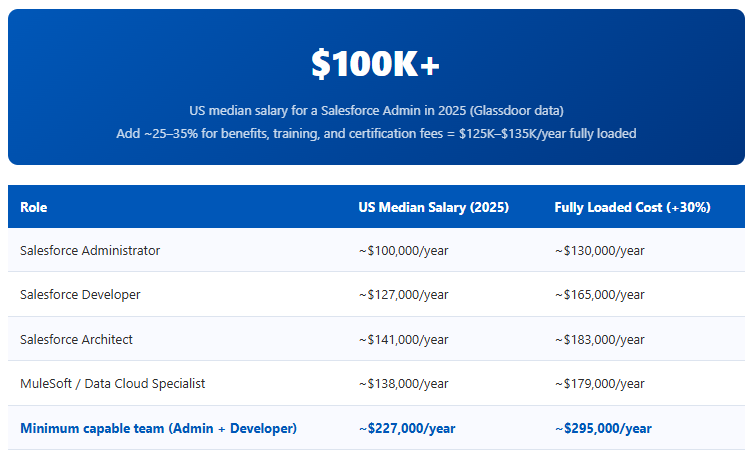
Compare that to a Salesforce managed services engagement:
Hidden cost often ignored: When an in-house Salesforce specialist leaves — and turnover in this market is high — you face months of recruitment (often 3–6 months), knowledge transfer loss, and interim gaps in platform support. MSPs contractually mitigate this risk with team redundancy and knowledge documentation.
If you're evaluating this decision in 2026, Agentforce is the elephant in the room. Salesforce's AI agent platform — which grew 119% in the first half of 2025 and became Salesforce's fastest-growing product ever — requires a new category of expertise that most in-house teams simply don't have.
Agentforce enables businesses to deploy autonomous AI agents that can:
Building and governing these agents requires expertise in Data Cloud configuration, Atlas Reasoning Engine architecture, prompt engineering, security (Einstein Trust Layer), and multi-agent orchestration. This is specialist knowledge — and the Salesforce talent market reflects it, with AI/Agentforce skills commanding 25–35% salary premiums over generalist roles.
AppShark's Agentforce Advantage: As a certified Salesforce partner with dedicated Agentforce practice capabilities, AppShark's managed services team brings AI agent implementation expertise that most in-house hires cannot match. Our clients gain access to Agentforce specialists without the premium hiring cost.
Choose Salesforce Managed Services When:
Choose an In-House Team When:
Not all managed services providers are created equal. When evaluating partners, ask these qualifying questions:
AppShark is a Salesforce certified partner with deep expertise across the full Salesforce ecosystem — from Sales Cloud and Service Cloud to Data Cloud, Agentforce, MuleSoft, and Field Service. Our managed services offering provides a flexible, cost-effective alternative to building and maintaining an in-house team.
When you partner with AppShark for managed Salesforce services, you get:
Ready to explore what Salesforce managed services could look like for your business?
Schedule a free consultation with our team, or email us at sales@appshark.com.
Salesforce managed services typically cost between $2,000 and $10,000+ per month on a retainer model, depending on the scope of services, hours required, and team composition. Hourly rates range from $100–$200/hour for experienced Salesforce consultants. This is generally 30–50% less than the fully loaded cost of maintaining an equivalent in-house team, which runs $230,000–$300,000+ per year when salary, benefits, training, and recruitment are included.
A Salesforce admin is a single professional — either internally hired or contracted — who manages your org's day-to-day configuration, user management, and basic automation. A Salesforce managed services provider (MSP) is a full team that includes admins, developers, architects, data specialists, and release managers. MSPs offer broader coverage, faster scaling, and access to specialized skills (like Agentforce, MuleSoft, or Data Cloud) that a single admin cannot provide.
Salesforce managed services typically include: user and license administration, custom development (Apex, LWC), workflow and automation management, Salesforce release readiness and updates, integration management (MuleSoft, third-party APIs), security audits and compliance monitoring, reporting and dashboard development, Agentforce/AI agent implementation, and strategic Salesforce roadmapping. The exact scope depends on your MSP agreement.
Key signals that it's time to consider managed services: your Salesforce backlog is consistently growing, your in-house team can't keep up with release updates, a key team member recently left or is likely to leave, you need capabilities your team doesn't have (e.g., Data Cloud, Agentforce, CPQ), or your Salesforce spend is rising without clear ROI. If you're spending more than 20% of your team's time on Salesforce maintenance instead of strategic work, an MSP conversation is overdue.